


Starting a business in Singapore is highly sought after by both local and international entrepreneurs. This is largely due to the many benefits that the Lion City has to offer. With that said, a new company registration in Singapore may come across as tedious and complex.
While it does come with its fair share of hurdles, starting a company is actually much easier than it seems. Here’s everything you need to know on how to register a company in Singapore:
Why Singapore?

(Source – Elements.Envato)
Singapore is one of the most business-friendly places to start a company. For starters, the government has made company registration relatively easy.
The process is transparent and efficient with many businesses being incorporated within a day—especially with help from incorporation services. Factors like digital registration, minimal bureaucracy and low capital requirements all contribute to this simple process.
On top of that, the tax regime is highly attractive for both startups and established companies. The tax rates are low (17%) and start-ups can benefit from significant tax exemptions for their first three consecutive Years of Assessment (YA).
The availability of skilled workers should also be taken into account, as Singaporeans are skilled and multilingual.
Types of Company Structures in Singapore

(Source – Elements.Envato)
There are different types of company structures in Singapore. Each type suits a specific operation scale—so it’s important to choose the right one for your business. There are 5 main types of business structures to choose from:
Private Limited Companies (Pte Ltd)
A Pte Ltd is the most common type of business in Singapore. It is a separate legal entity from its owners, meaning the company can own assets, enter contracts or even sue in its own name.Shareholders enjoy limited liability, which protects their personal assets beyond their investment in the company. This structure is ideal for startups and growing businesses due to its scalability and credibility.
Sole Proprietorship
This is commonly considered the second most popular business type. It is also the most simple business structure to own and manage by a single person.While it is easy to set up and has minimal compliance requirements, the owner is personally liable for all debts and losses. This means your personal assets are not protected.
Partnership
A partnership involves two or more individuals running a business together. Similar to a sole proprietorship, partners are personally liable for the business’s obligations.It’s suitable for small businesses but carries higher risk due to shared liability.
Public Companies
A public company is a larger business structure that can offer its shares to the public. There are two main types—public companies limited by shares and public companies limited by guarantees.A public company limited by shares is typically listed on the stock exchange. On the other hand, a public company limited by guarantee is usually set up for non-profit purposes.While public companies provide greater access to capital, they are subject to stricter regulations.
Limited Liability Partnership (LLP)
An LLP combines the flexibility of a partnership with the benefits of limited liability. It is a separate legal entity from its partners, meaning the business can own assets and enter contracts in its own name.
Partners are not personally liable for the debts of the LLP beyond their agreed contribution, which helps protect their personal assets.
Step-By-Step Guide on How to Register a Company in Singapore
(Source: bizfile.gov.sg)
1. Choose Business Name
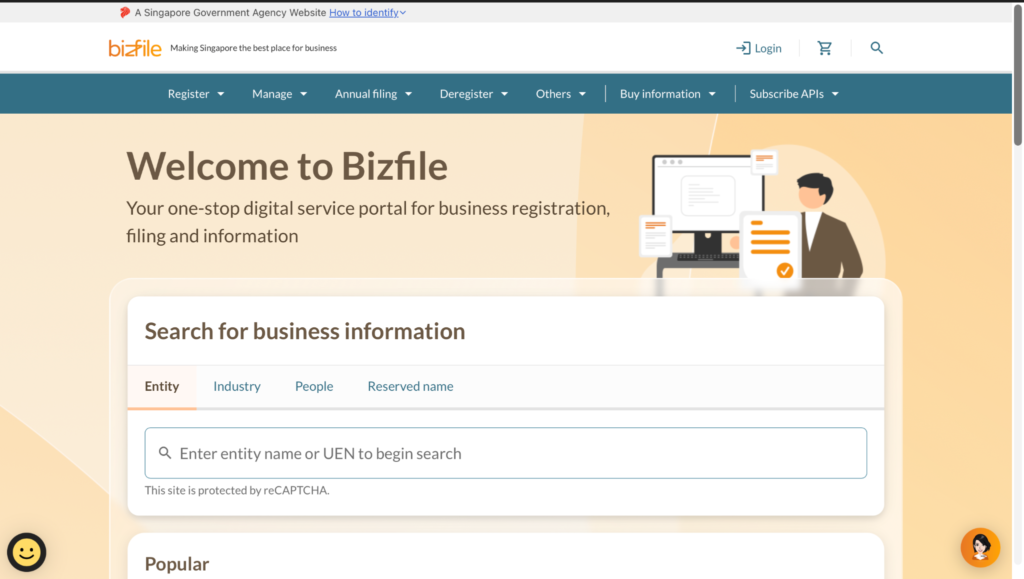
The first step is to pick a business entity name. Before that, it is important to search up potential names in Accounting and Corporate Regulatory Authority (ACRA) Bizfile. This is to ensure that your potential company name has not been taken.
There are also certain restricted words that may require prior approval before they can be used in your business name. These include terms such as ‘bank’, ‘university’, ‘education’, or ‘Singapore’, among others. In addition, to avoid potential copyright or trademark issues with existing companies, it is advisable to steer clear of names that are identical or overly similar.
2. Choose Business Structure
After choosing your business name, the next step is to determine your business structure. As mentioned above, the most popular business structure is a Pte Ltd. This is the preferred choice for most startups due to its many benefits.
However, the right choice ultimately depends on your goals and level of risk you’re willing to take—so remember to carefully evaluate each option as changing your business structure later on can be more complex and costly.
3. Choose Primary Activity
Next, you will need to choose your business activity according to the right SSIC code. An SSIC code is Singapore’s system for classifying business activities.
Depending on the nature of your business, it is important to choose a code that describes your primary and secondary (if applicable) business activities. Choosing the right code is crucial, as misclassification can lead to regulatory issues.
4. Prepare Required Documents
To ease the registration process, each director and shareholder should prepare the required documentation. This includes your NRIC/passport and proof of residential address.
A foreign founder must also appoint at least one resident director to comply with Singapore’s regulations.
With a minimum of S$1, you must then decide how much initial capital to inject into your business along with how the ownership of shares will be distributed. Lastly, you will need a registered business address which can be a home, office or even virtual address.
5. Appoint Company Secretary
You must appoint a company secretary within 6 months of incorporation. Leaving this position vacant beyond this period may result in penalties of up to S$1000. The same person cannot act as both the sole director and company secretary.
However, if your company has at least two directors, one individual can hold both roles. The secretary is responsible for preparing and submitting documents to statutory bodies like ACRA.
They ensure your company meets all regulatory requirements while remaining compliant with Singapore laws. You can either hire a full time secretary or outsource professional secretarial services.
6. Register With ACRA
Finally, you will need to register your company with ACRA through the Bizfile portal. This is the official step that legally incorporates your business in Singapore. During registration, you will need to submit all the information prepared earlier. This includes:
- Company Name
- Business Structure
- SSIC Code
- Details of directors and shareholders
- Registered Business Address
- Company Secretary Information
If all details are correct, your application will be processed quickly—often within a day or even a few hours. After approval, you will receive your Unique Entity Number (UEN), which serves as your company’s official identification for all business transactions.
The Bottom Line
A new company registration in Singapore can be smooth and easy when you know the right steps. Nevertheless, getting the right help is not only a good way to speed up the process but also ensures that everything is done correctly from the start.
Ultimately, Singapore offers one of the most straightforward and supportive environments for starting a company. With proper planning and the right guidance, your business can be up and running in no time.
Looking to register a company in Singapore? Visit onetaxcm.com or contact us to find out more!